Today's
EarthStation1.com 15% Off Commemorative Memorial Title: American
Art & The Metropolitan Museum 1650-1914 DVD, MP4, USB Drive
Today, May 18, 2026
May 18: International Museum Day: --
Since 1977, The International Council of Museums (I.C.O.M.) has
celebrated this day annually to pay tribute to the international
museum community. Museums are vital venues for cultural exchange
and enrichment, as well as for the development of peaceful
coexistence and cooperation among nations and communities. This
day encourages people to visit museums dedicated to many fields of
human endeavor such as agriculture, fashion, astronomy,
archaeology, art, and natural history. Together, let us embark on
a journey to museums and learn about our historic past. In 1951,
I.C.O.M. held a meeting named "Crusade for Museums"
during which the international museum community debated the theme
"Museums and Education." The strategy for museum
accessibility was established at this meeting and served as
inspiration for the creation of International Museum Day.
International Museum Day was first observed in 1977 in Moscow when
the I.C.O.M. General Assembly adopted a resolution calling for the
establishment of an annual event to further integrate creative
objectives and museum efforts aimed at directing the world's
attention to the contributions of museums to humankind. It also
pushes for the idea that museums are channels by which to promote
mutual understanding, interaction, and world peace. Every year,
the organization decides on a new theme. Since 1977, all museums
across the world have been asked to organize and take part in
activities to raise awareness about the importance of museums to
society. Since its inception, International Museum Day has
progressively grown in popularity. The number of participants has
risen steadily over the last 15 years - a testament to the fact
that the study of history allows us to understand how societies
behaved. Today, more people than ever before visit museums all
over the world. There are also more people studying history at
universities now than at any other time. On Sale @ 15% Off
Discount Till Midnight PT!
https://store.earthstation1.com/american-art-and-the-metropolitan-museum-165016501914.html
Today's
EarthStation1.com 15% Off Commemorative Memorial Title: The Old
Time Radio Horror & Suspense MP3 MegaSet DVD, Download, USB
Today, May 18, 2026
May 18, 1048: #BOTD: #HBD! Omar Khayyam,
Persian polymath, mathematician, astronomer, author of the famed
collection of poems known as "The Rubaiyat Of Omar Khayyam"
(d. 1131) #born Ghiyath al-Din Abu al-Fath Umar Ibn Ibrahim
Nisaburi in Nishapur in modern Northeastern Iran (the Persian
historian Bayhaqi, who knew him, provides in the full details of
his horoscope that "he was Gemini, the sun and Mercury being
in the ascendant", which is used by modern scholars to
establish his date of birth). As a mathematician, he is most
notable for his work on the classification and solution of cubic
equations, among other thins. As an astronomer, he designed the
Jalali Calendar, a solar calendar with a very precise 33-year
intercalation cycle that provided the basis for the Persian
calendar that is still in use after nearly a millennium.
(Intercalation or embolism in timekeeping is the insertion of a
leap day, week, or month into some calendar years.) Khayyam
announced in 1079, that the length of the year was measured as
365.24219858156 days. Given that the length of the year is
changing in the sixth decimal place over a person's lifetime, this
is outstandingly accurate. For comparison the length of the year
at the end of the 19th century was 365.242196 days, while today it
is 365.242190 days. There is a tradition of attributing poetry to
Omar Khayyam, written in the form of quatrains (Rubaiyat). This
poetry became widely known to the English-reading world in a
translation by Edward FitzGerald (Rubaiyat of Omar Khayyam, 1859),
which enjoyed great success in the Orientalism of the fin de
siecle. On Sale @ 15% Off Discount Till Midnight PT!
https://store.earthstation1.com/the-old-time-radio-horror-and-suspense-megaset-dual-layer-mp3-dv3.html
Today's
EarthStation1.com 15% Off Commemorative Memorial Title: Desiree
(1954) Marlon Brandon As Napoleon DVD, Download, USB Drive
Today, May 18, 2026
May 18, 1804: The Age Of Enlightenment
(The Enlightenment, The Age Of Reason): The Age Of Revolution: The
Atlantic Revolutions: The French Revolution: The First French
Empire (The French Republic, The French Empire (French: Empire
Francais; Latin: Imperium Francicum), Napoleonic France): Emperor
Of The French (French: Empereur Des Francais): The House Of
Bonaparte: Napoleon I (Napoleon Bonaparte, Napoleone Di
Buonaparte): -- Napoleon Bonaparte is proclaimed Emperor Of The
French by the French Senate, the title of the monarch and supreme
ruler of the First French Empire. Emperor Of The French was the
title of the monarch and supreme ruler of the First and the Second
French Empires. The title and office Emperor Of The French was
used by the House of Bonaparte, a title that emphasized that the
emperor ruled over "the French people" (the nation) and
not over France (the state). The old formula of "The King Of
France" indicated that the king owned France as a personal
possession. The new term indicated a constitutional monarchy. The
title was purposely created to preserve the appearance of the
French Republic and to show that after the French Revolution, the
feudal system was abandoned and a nation state was created, with
equal citizens as the subjects of their emperor. After January 1,
1809, the state was officially referred to as The French Empire.
The title of "Emperor of the French" was supposed to
demonstrate that Napoleon's coronation was not a restoration of
the monarchy, but an introduction of a new political system: the
French Empire. Napoleon's reign lasted until 22 June 1815, when he
was defeated at the Battle of Waterloo, exiled, and imprisoned on
the island of Saint Helena, where he died on 5 May 1821. His reign
was interrupted by the Bourbon Restoration of 1814 and his exile
to Elba, from where he escaped less than a year later to reclaim
the throne, reigning as Emperor for another 111 days before his
final defeat and exile. Taking the title "emperor" also
emphasized that the will of the citizens of France was equal in
sovereignty to anyone's, and especially to what had been until
this time the highest sovereignty in the Western world: the (Holy)
Roman Emperor derived from the ancient Roman Emperors, and whose
sovereignty stemmed from God, as indicated by his coronation by
the Pope. Less than a year after the 1851 French coup d'etat by
Napoleon's nephew Louis-Napoleon Bonaparte, which ended in the
successful dissolution of the French National Assembly, the French
Second Republic was transformed into the Second French Empire,
established by a referendum on 7 November 1852. President
Bonaparte, elected by the French people, officially became
Napoleon III, Emperor of the French, from the symbolic and
historic date of 2 December 1852. His rule would de facto end on
July 28, 1870 - the power of the head of state was transferred to
his wife Eugenie de Montijo who would rule as empress regent of
France while Napoleon III left with his army. His reign would
nominally continue until 4 September 1870, as he was officially
deposed after his defeat and capture at the Battle of Sedan during
the Franco-Prussian War. In March of 1871, he would be released
from Prussian custody and exiled to the United Kingdom, where he
died on January 9, 1873. Since the death of Napoleon III's only
son, Louis-Napoleon in 1879, the House of Bonaparte has had a
number of claimants to the French throne. As of 2024, the current
claimant is Charles, Prince Napoleon, who became head of the House
of Bonaparte on May 3, 1997. His position is challenged by his
son, Jean-Christophe, Prince Napoleon, who was named as heir in
his late grandfather's testament. On Sale @ 15% Off Discount Till
Midnight PT!
https://store.earthstation1.com/desiree-1954-dvd-marlon-brando-as-napoleon-jean-sim1954.html
Today's
EarthStation1.com 15% Off Commemorative Memorial Title: The Siege
Of Vicksburg American Civil War DVD MP4 Download USB Drive
Today, May 18, 2026
May 18, 1863: The American Civil War (The
Civil War, The War Between The States): The Western Theater Of The
American Civil War: The Vicksburg Campaign: The Siege Of
Vicksburg: -- The final major military action in the Vicksburg
Campaign begins with The Siege Of Vicksburg (May 18 - July 4,
1863) against the last major Confederate stronghold on the
Mississippi River. The successful ending of the Vicksburg Campaign
significantly degraded the ability of the Confederacy to maintain
its war effort. The Confederate surrender of Vicksburg on July 4,
1863 is sometimes considered, when combined with Gen. Robert E.
Lee's defeat at Gettysburg by Maj. Gen. George Meade, the turning
point of the war. It cut off the states of Arkansas, Louisiana,
and Texas from the rest of the Confederate States, effectively
splitting the Confederacy in two for the duration of the war. The
Union victory also permanently severed communication between the
Trans-Mississippi Department and the balance of the Confederacy.
Lincoln called Vicksburg "The key to the war." On Sale @
15% Off Discount Till Midnight PT!
https://store.earthstation1.com/the-siege-of-vicksburg-american-civil-war-dvd-mp4-download-usb-driv4.html
Today's
EarthStation1.com 15% Off Commemorative Memorial Title: Peter
Ustinov's Russia TV Documentary Series DVD, Video Download, USB
Today, May 18, 2026
May 18 [O.S. May 6], 1868: #BOTD:
Nicholas II Of Russia, also known as Nikolai II Alexandrovich
Romanov, known in the Russian Orthodox Church as Saint Nicholas
The Passion-Bearer, the last Emperor of Russia, ruling from
November 1, 1894 until his forced abdication on March 15, 1917 (d.
July 17, 1918) is #born Nikolai Alexandrovich Romanov in the
Alexander Palace in Tsarskoye Selo, Russian Empire, south of Saint
Petersburg. His reign saw the fall of the Russian Empire from one
of the foremost great powers of the world to economic and military
collapse. He was given the nickname Nicholas the Bloody by his
political adversaries due to the Khodynka Tragedy, anti-Semitic
pogroms, Bloody Sunday, the violent suppression of the 1905
Russian Revolution, the executions of political opponents, and his
perceived responsibility for the Russo-Japanese War. Soviet
historians portray Nicholas as a weak and incompetent leader whose
decisions led to military defeats and the deaths of millions of
his subjects. Russia was defeated in the 1904-05 Russo-Japanese
War which saw the annihilation of the Russian Baltic Fleet at the
Battle Of Tsushima, the loss of Russian influence over Manchuria
and Korea, and the Japanese annexation of South Sakhalin. The
Anglo-Russian Entente was designed to counter the German Empire's
attempts to gain influence in the Middle East, but it ended the
Great Game of confrontation between Russia and the United Kingdom.
Nicholas approved the Russian mobilization on July 30, 1914 which
led to Germany declaring war on Russia on August 1, 1914. It is
estimated that around 3.3 million Russians were killed in the
First World War. The Imperial Russian Army's severe losses, the
High Command's incompetent management of the war efforts, and the
lack of food and supplies on the Home Front were the leading
causes of the fall of the House of Romanov. Following the February
Revolution of 1917, Nicholas abdicated on behalf of himself and
his son. He and his family were imprisoned and transferred to
Tobolsk in late summer 1917. On April 30, 1918, Nicholas,
Alexandra, and his mother Marie were handed over to the local Ural
Soviet in Ekaterinburg; the rest of the captives followed on May
23. Nicholas and his family were eventually murdered by their
Bolshevik guards on the night of July 16/17, 1918. The remains of
the imperial family were re-interred in St. Petersburg 80 years
later on July 17, 1998. In 1981, Nicholas, his wife, and their
children were recognized as martyrs by the Russian Orthodox Church
Outside Russia in New York City. On August 15, 2000, they were
canonized by the Russian Orthodox Church as passion bearers,
commemorating believers who face death in a Christ-like manner. On
Sale @ 15% Off Discount Till Midnight PT!
https://store.earthstation1.com/peter-ustinov39s-russia-dvds-complete-6-part-tv-series-2-d3962.html
Today's
EarthStation1.com 15% Off Commemorative Memorial Title: Bertrand
Russell: Face To Face Interview MP4 Video Download Or DVD
Today, May 18, 2026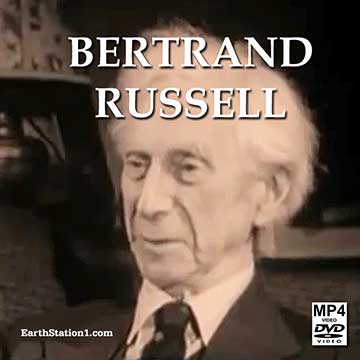
May 18, 1872: #BOTD: #HBD! Bertrand
Russell, British philosopher, logician, mathematician, public
intellectual and Nobel Prize In Literatue recipient who influenced
mathematics, logic, set theory, and various areas of analytic
philosophy, free love advocate (d. February 2, 1970) is #born at
Ravenscroft, a country house in Trellech, Monmouthshire,
South-East Wales into an influential and liberal family of the
British aristocracy; although he was born in Monmouthshire, and
died in Penrhyndeudraeth ("PEN-DREN-DAY-dryth"),
Merionethshire, both in Wales, Russell identified as English.
Bertrand Arthur William Russell, 3rd Earl Russell's parents were
Viscount and Viscountess Amberley. Both were early advocates of
birth control at a time when this was considered scandalous. Lord
Amberley consented to his wife's relationship with their
children's tutor, the biologist Douglas Spalding. Lord Amberley, a
deist, asked the philosopher John Stuart Mill to act as Russell's
secular godfather. Mill died the year after Russell's birth, but
his writings later influenced Russell's life. Bertrand Russell was
one of the early 20th century's prominent logicians and a founder
of analytic philosophy, along with his predecessor Gottlob Frege,
his friend and colleague G. E. Moore, and his student and protege
Ludwig Wittgenstein. Russell with Moore led the British "revolt
against idealism". Together with his former teacher Alfred
North Whitehead, Russell wrote Principia Mathematica, a milestone
in the development of classical logic and a major attempt to
reduce the whole of mathematics to logic (Logicism). Russell's
article "On Denoting" has been considered a "paradigm
of philosophy". Russell was educated at Trinity College at
the University of Cambridge, where he graduated in 1893. He was a
pacifist who championed anti-imperialism and chaired the
England-based India League. He went to prison for his pacifism
during the First World War, and he initially supported appeasing
Adolf Hitler's Nazi Germany, before changing his view in 1943,
describing war as a necessary "lesser of two evils". In
the wake of the Second World War, he welcomed American global
hegemony in preference to either Soviet hegemony or no (or
ineffective) world leadership, even if it were to come at the cost
of using their nuclear weapons. He would later criticise Stalinist
totalitarianism, condemn the United States' involvement in the
Vietnam War, and become an outspoken proponent of nuclear
disarmament. In 1950 Russell was awarded the Nobel Prize in
Literature "in recognition of his varied and significant
writings in which he champions humanitarian ideals and freedom of
thought". He was also the recipient of the De Morgan Medal
(1932), Sylvester Medal (1934), Kalinga Prize (1957), and
Jerusalem Prize (1963). Bertrand Russell died of influenza just
after 8 pm at his home in Penrhyndeudraeth, aged 97. His body was
cremated on February 5, 1970 in Colwyn Bay, a town Conwy County
Borough on the north coast of Wales overlooking the Irish Sea,
with five people present. In accordance with his will, there was
no religious ceremony but one minute's silence; his ashes were
later scattered over the Welsh mountains.] On October 23, 1970,
his will was published showing he had left an estate valued at
69,423 PS (equivalent to 1.4M PS in 2023). In 1980, a memorial to
Russell was commissioned by a committee including the philosopher
A. J. Ayer. It consists of a bust of Russell in Red Lion Square in
London sculpted by Marcelle Quinton. #BertrandRussell
#Philosophers #Logicians #Mathematicians #PublicIntellectuals
#Intellectuals #NobelPrizeRecipients #NobelPrizeInLiteratue
#NobelPrizeInLiteratueRecipients #Mathematics #Logic #SetTheory
#Philosophy #AnalyticPhilosophy #Logicism #JohnFreeman
#JohnFreemanBritishPolitician #FaceToFace
#FaceToFaceBritishTVProgram #FaceToFaceBritishTVProgramme #MP4
#VideoDownload #DVD On Sale @ 15% Off Discount Till Midnight PT!
https://store.earthstation1.com/bertrand-russell-face-to-face-interview-mp4-video-download-or-dvd.html
Today's
EarthStation1.com 15% Off Commemorative Memorial Title: The Road
To Brown: Battle Against Plessy v Ferguson DVD Download USB
Today, May 18, 2026
May 18, 1896: Anti-Black Racism:
Anti-Black Racism In The United States: Racial Segregation: Jim
Crow Laws: Separate But Equal: The Nadir Of American Race
Relations (1877/1890 - 1901/1923/1941 [Dates Disputed]): Plessy V.
Ferguson: -- In what is widely regarded as the worst decision in
U.S. Supreme Court history, the United States Supreme Court issues
a 7-1 decision that the "separate but equal" doctrine is
constitutional, stating that although the Fourteenth Amendment
established the legal equality of whites and blacks, it did not
and could not require the elimination of all "distinctions
based upon color". Justice John Marshall Harlan was the lone
dissenter from the Court's decision, writing that the U.S.
Constitution "is color-blind, and neither knows nor tolerates
classes among citizens", and so the law's distinguishing of
passengers' races should have been found unconstitutional. Plessy
v. Ferguson, 163 U.S. 537 (1896), was a landmark decision of the
United States Supreme Court in which the Court ruled that racial
segregation laws did not violate the U.S. Constitution as long as
the facilities for each race were equal in quality, a doctrine
that came to be known as "separate but equal". The
decision legitimized the many state laws re-establishing racial
segregation that had been passed in the American South after the
end of the Reconstruction Era (1865-1877). The underlying case
began in 1892 when Homer Plessy, a mixed-race resident of New
Orleans, deliberately violated Louisiana's Separate Car Act of
1890, which required "equal, but separate" railroad
accommodations for white and non-white passengers. Plessy was
charged with boarding a "whites-only" car, and his
lawyers petitioned Judge John Howard Ferguson to throw out the
case on the grounds that the law was unconstitutional. Ferguson
overruled Plessy's petition, and the Louisiana Supreme Court
upheld Ferguson's ruling. Plessy then appealed to the U.S. Supreme
Court. On May 18 1896, in an opinion written by Justice Henry
Billings Brown, the Supreme Court ruled against Plessy, stating
that the Louisiana law did not violate either the Thirteenth or
the Fourteenth Amendment to the U.S. Constitution. The Court
rejected Plessy's lawyers' arguments that the Louisiana law
inherently implied that black people were inferior, and gave great
deference to American state legislatures' inherent power to make
laws regulating health, safety, and morals - the "police
power" - and to determine the reasonableness of the laws they
passed. Despite its infamy, the decision has never been explicitly
overruled. But a series of the Court's later decisions, beginning
with the 1954 decision Brown v. Board of Education - which held
that the "separate but equal" doctrine is
unconstitutional in the context of public schools and educational
facilities - have so severely weakened an annulled Plessy to the
point that it is considered to have been de facto overruled. On
Sale @ 15% Off Discount Till Midnight PT!
https://store.earthstation1.com/the-road-to-brown-battle-against-plessy-v-ferguson-dvd-download-usb.html
Today's
EarthStation1.com 15% Off Commemorative Memorial Title: Why We
Fight All 8 Episodes Of All 7 Films DVD MP4 Download USB Drive
Today, May 18, 2026
May 18, 1897: #BOTD: #HBD! Frank Capra,
Sicilian American Hollywood director, producer and writer (d.
September 3, 1991) is #born Francesco Rosario Capra in Palermo,
Sicily. Frank Russell Capra was the creative force behind some of
the major award-winning films of the 1930s and 1940s. Raised in
Los Angeles from the age of five, his rags-to-riches story has led
film historians such as Ian Freer to consider him the "American
dream personified.". Capra became one of America's most
influential directors during the 1930s, winning three Oscars from
his six nominations as Best Director, along with three other Oscar
wins from nine nominations in other categories. Among his leading
films were It Happened One Night (1934), You Can't Take It with
You (1938), and Mr. Smith Goes to Washington (1939); Capra was
nominated as Best Director and as producer for Academy Award for
Best Picture on all three films, winning both awards on the first
two. During World War II, Capra served in the U.S. Army Signal
Corps and produced propaganda films, such as the Why We Fight
series. After World War II, Capra's career declined as his later
films, such as It's a Wonderful Life (1946), performed poorly when
they were first released. In ensuing decades, however, It's a
Wonderful Life and other Capra films were revisited favorably by
critics. His quintessential American films were affectionate
portrayals of the common man and examined the strengths and
foibles of American democracy. Outside of directing, Capra was
active in the film industry, engaging in various political and
social issues. He served as President of the Academy of Motion
Pictures Arts and Sciences, worked alongside the Screenwriters
Guild, and was head of the Directors Guild of America. Best known
for It's a Wonderful Life (1946), Mr. Smith Goes to Washington
(1939), It Happened One Night (1934) and You Can't Take It with
You (1938). Frank Capra died of a heart attack in his sleep at his
La Quinta, California home, aged 94. He was interred at Coachella
Valley Public Cemetery in Coachella, California. He left part of
his 1,100-acre (445 ha) ranch in Fallbrook, California, to the
California Institute of Technology, to be used as a retreat
center. Capra's personal papers and some film-related materials
are contained in the Wesleyan University Cinema Archives, which
allows scholars and media experts full access. He is buried at
Coachella Valley Public Cemetery in Coachella, California. On Sale
@ 15% Off Discount Till Midnight PT!
https://store.earthstation1.com/why-we-fight-dvds-all-8-episodes-of-all-7-films-5-di875.html
Today's
EarthStation1.com 15% Off Commemorative Memorial Title: Rhythm And
Blues Revue (1955) DVD, MP4 Video Download, USB Flash Drive
Today, May 18, 2026
(NOTE: #JCKaelin here: My father's life
was rocked (and rolled) when he first heard Big Joe Turner's
"Shake, Rattle And Roll" play on the radio as an
eighteen-year-old in 1954. It confirmed him as a rock and roll fan
in general, and of authentic black rhythm and blues in particular.
He understood the risque lyrics for what they were, and so, she
thought, did his mother. After he succeeded in purchasing a 78 RPM
record of the song by mail, she heard him play it, burst into his
room, and broke it, exclaiming "I know what those lyrics
mean! He's really singing "Shake Marilyn Monroe!" He
wasn't, of course, but it is a great example of how many white
parents reacted to the black music their children were beginning
to listen to at the time ;) ) ========= May 18, 1911: #BOTD: #HBD!
Big Joe Turner, African American blues shouter, rhythm and
blues/jazz singer from Kansas City, Missouri (d. 1985) is #born
Joseph Vernon Turner Jr. According to songwriter Doc Pomus, "Rock
and roll would have never happened without him." His greatest
fame was due to his rock-and-roll recordings in the 1950s,
particularly his landmark "Shake, Rattle and Roll", but
his career as a performer, particularly as a jazz singer in Kansas
City, endured from the 1920s into the 1980s. Turner was inducted
into the Rock and Roll Hall of Fame in 1987, with the Hall lauding
him as "the brawny voiced 'Boss of the Blues'". Shake,
Rattle and Roll was rock and roll's breakthrough song to the
general public. It is a twelve bar blues-form song, written in
1954 by Jesse Stone under his songwriting pseudonym of Charles E.
Calhoun. In early 1954, Ahmet Ertegun of Atlantic Records
suggested to Stone that he write an up-tempo blues for Turner.
Stone played around with various phrases before coming up with
"shake, rattle and roll". However, the phrase had been
used in earlier songs. In 1910, vaudeville performer "Baby"
Franklin Seals published "You Got to Shake, Rattle and Roll",
a ragtime tune about gambling with dice, in New Orleans; in 1919,
Al Bernard recorded a version of the song. The phrase is also
heard in "Roll the Bones" by the Excelsior Quartette in
1922. Turner's version was recorded in New York City on February
15, 1954. The shouting chorus on his version consisted of Jesse
Stone, and record label executives Jerry Wexler and Ahmet Ertegun.
The saxophone solo was by Sam "The Man" Taylor. Other
players included McHouston "Mickey" Baker ("Love is
Strange") on guitar and drummer Connie Kay (later from the
Modern Jazz Quartet). Turner's recording was released in April
1954, reached number one on the U.S. Billboard R & B chart on
June 12, did not move for three weeks, and peaked at number 22,
nearly at the same time, on the Billboard pop chart (subsequently
billed as the Billboard Hot 100). The song, in its original
incarnation, is highly sexual. Perhaps its most salacious lyric,
which was absent from the later Bill Haley rendition, is "I've
been holdin' it in, way down underneath / You make me roll my
eyes, baby, make me grit my teeth". On the recording, Turner
slurred the lyric "holdin' it in", since this line may
have been considered too risque for publication. The chorus used
"shake, rattle and roll" to refer to boisterous
intercourse, in the same way that the words "rock and roll"
were first used by numerous rhythm and blues singers, starting
with Trixie Smith's "My Man Rocks Me (With One Steady Roll)"
in 1922, and continuing on prominently through the 1940s and
1950s. Stone stated that the line about "a one-eyed cat
peepin' in a seafood store" was suggested to him by Atlantic
session drummer Sam "Baby" Lovett, which is also a sly
sexual reference, the "one-eyed cat" being the male
organ and the more traditional "seafood" reference being
the female organ. On Sale @ 15% Off Discount Till Midnight PT!
https://store.earthstation1.com/rhythm-and-blues-revue-dvd-1955-apollo-theater-tv-1955.html
Today's
EarthStation1.com 15% Off Commemorative Memorial Title: Paul
Winchell And Jerry Mahoney TV Shows DVD, MP4 Download, USB Drive
Today, May 18, 2026
May 18, 1912: #BOTD: #HBD! Perry Como,
nicknamed "Mr. C.", American singer, actor and
television personality (d. May 12, 2001) is #born Pierino Ronald
Como in Canonsburg, Pennsylvania, about 20 miles southwest of
Pittsburgh, the seventh of 13 children and the first American-born
child of Italian immigrants Pietro Como (1877-1945) and Lucia
Travaglini (1883-1961), who both emigrated to the US in 1910 from
the Abruzzese town of Palena, Italy. Perry Como did not begin
speaking English until he entered school, since the Comos spoke
Italian at home. The family had a second-hand organ that his
father had bought for 3 bucks; as soon as Como was able to toddle,
he would head to the instrument, pump the bellows, and play music
that he had heard. During a career spanning more than half a
century, Perry Como recorded exclusively for RCA Victor for 44
years, after signing with the label in 1943, selling millions of
records and pioneering a weekly musical variety television show.
His weekly television shows and seasonal specials were broadcast
throughout the world. In the official RCA Records Billboard
magazine memorial, his life was summed up in these few words: "50
years of music and a life well lived. An example to all."
Como received five Emmys from 1955 to 1959, a Christopher Award
(1956) and shared a Peabody Award with good friend Jackie Gleason
in 1956. He was inducted into the Academy of Television Arts &
Sciences Hall of Fame in 1990 and received a Kennedy Center Honor
in 1987. Posthumously, Como received the Grammy Lifetime
Achievement Award in 2002, and he was inducted into the Long
Island Music Hall of Fame in 2006. He has the distinction of
having three stars on the Hollywood Walk of Fame for his work in
radio, television, and music. Perry Como died in his sleep at his
home in Jupiter Inlet Colony, Florida, six days before his 89th
birthday. He was reported to have suffered from symptoms of
Alzheimer's disease. Como's older son, Ronnie, and his daughter,
Terri, could not agree on their interpretations of Como's 1999
living will and it became a matter for the courts in the year
before his death. His funeral Mass took place at St. Edward's
Catholic Church in Palm Beach, Florida. Como and his wife,
Roselle, are buried at Riverside Memorial Park, Tequesta, Palm
Beach County, Florida. On Sale @ 15% Off Discount Till Midnight
PT!
https://store.earthstation1.com/paul-winchell-and-jerry-mahoney-2-dual-layer-dvd-se2.html
Today's
EarthStation1.com 15% Off Commemorative Memorial Title: World War
1 TV Series With Robert Ryan DVD, Video Download, USB Drive
Today, May 18, 2026
May 18, 1917: The European Civil War:
World War I: The First European War (The European Theater Of World
War I): The Western Front Of World War I: The United States In
World War I: The Selective Service Act Of 1917: -- The President
of the United States, and thereby the Federal government of the
United States, is granted the power to raise a national army for
service in World War I through conscription with the passage of
The Selective Service Act Of 1917. It was envisioned in December
1916 and brought to President Woodrow Wilson's attention shortly
after the break in relations with Germany in February 1917. The
Act itself was drafted by then Captain (later Brigadier General)
Hugh S. Johnson after the United States entered World War I by
declaring war on Germany. The Act was canceled with the end of the
war on November 11, 1918. The Act was upheld as constitutional by
the United States Supreme Court in 1918. On Sale @ 15% Off
Discount Till Midnight PT!
https://store.earthstation1.com/world-war-1-robert-ryan-4-dual-layer-dvds-26-episode-tv-se1426.html
Today's
EarthStation1.com 15% Off Commemorative Memorial Title: The
Scarlett O'Hara War 1980 Tony Curtis Bill Macy DVD, Download, USB
Today, May 18, 2026
May 18, 1922: #BOTD: #HBD! Bill Macy,
American television, film and stage actor, best known for his role
in the CBS television series Maude (1972-1978) (d. October 17,
2019) is #born Wolf Martin Garber in Revere, Massachusetts, the
son of Mollie (nee Friedopfer; 1889-1986) and Michael Garber
(1884-1974), a manufacturer. He was raised Jewish in the East
Flatbush section of Brooklyn, New York. After graduating from
Samuel J. Tilden High School he served in the United States Army
from 1942 to 1946 with the 594th Engineer Boat and Shore Regiment,
stationed in the Philippines, Japan and New Guinea. He worked as a
cab driver for a decade before being cast as Walter Matthau's
understudy in Once More, with Feeling on Broadway in 1958. He
portrayed a cab driver on the soap opera The Edge of Night in
1966. Macy was an original cast member of the 1969-1972
Off-Broadway sensation Oh! Calcutta!, performing in the show from
1969 to 1971. He later appeared in the 1972 movie version of the
musical. Of appearing fully nude with the rest of the cast in the
stage show, he said, "The nudity didn't bother me. I'm from
Brooklyn." Macy performed on the P.D.Q. Bach album The Stoned
Guest (1970). Appreciating Macy's comedic skills off Broadway,
Norman Lear brought him to Hollywood, where he first got a small
part as a police officer in All In The Family. He was cast in the
role of Walter Findlay, the long-suffering husband of the title
character on the 1970s television sitcom Maude, starring Bea
Arthur. The show ran for six seasons from 1972 to 1978. Strangers
on the street often called him "Mr. Maude", consoling
him for having such a difficult wife. "I used to tell them
that people like that really existed," Macy explained. In
1986, Macy was a guest on the fourth episode of L.A. Law, playing
an older man whose young wife wants a music career. Macy appeared
in the television movie Perry Mason: The Case of the Murdered
Madam (1987) as banker Richard Wilson. He occasionally appeared on
Seinfeld as one of the residents of the Florida retirement
community where Jerry Seinfeld's parents lived. Macy made a guest
appearance as a patient on Chicago Hope and as an aging gambler on
the series Las Vegas. Macy's last television role occurred in a
2010 episode of Jada Pinkett Smith's series Hawthorne. Macy
appeared as the jury foreman in The Producers in 1967, with the
memorable sole line "We find the defendants incredibly
guilty". Other memorable roles include the co-inventor of the
"Opti-Grab" in the 1979 Steve Martin comedy The Jerk and
as the head television writer in My Favourite Year (1982). Other
film credits included roles in Death at Love House (1976), The
Late Show (1977), Serial (1980), Movers & Shakers (1985), Bad
Medicine (1985), Tales from the Darkside (1985 - "Lifebomb"
episode), Sibling Rivalry (1990), The Doctor (1991), Me Myself &
I (1992), Analyze This (1999), Surviving Christmas (2004), The
Holiday (2006), and Mr. Woodcock (2007). Macy met his future wife,
Samantha Harper, on the set of Oh! Calcutta! in 1969. In 1975,
Macy and Samantha Harper Macy appeared on the game show
Tattletales. They married in 1975. Macy died in Los Angeles,
California at the age of 97; no cause was given. His body was
cremated; the final disposition of his ashes are unknown. Norman
Lear said of him "He was a rare and great comic actor. There
was only one Bill Macy." On Sale @ 15% Off Discount Till
Midnight PT!
https://store.earthstation1.com/the-scarlett-o39hara-war-tv-movie-19391980.html
Today's
EarthStation1.com 15% Off Commemorative Memorial Title: Great
Depression Films Collection DVD, Video Download, USB Flash Drive
Today, May 18, 2026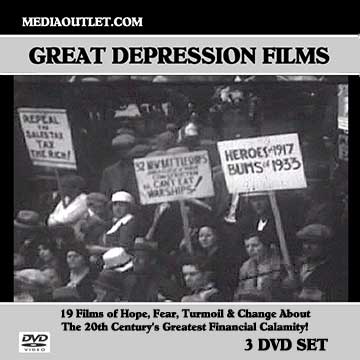
May 18, 1933: The Interwar Period (The
Interbellum, Between The Wars): The Presidency Of Franklin D.
Roosevelt: The Fireside Chats: The Great Depression: The Great
Depression In The United States: The New Deal: The First New Deal
(1933-1934): The Tennessee Valley Authority Act Of 1933 (The TVA
Act): -- Just over two months after first taking office, President
Franklin D. Roosevelt signs an act creating the Tennessee Valley
Authority. The TVA is a federally owned corporation in the United
States created by congressional charter to provide navigation,
flood control, electricity generation, fertilizer manufacturing,
and economic development to the Tennessee Valley, a region
particularly affected by the Great Depression. Senator
(R-Nebraska) was a strong sponsor of this project. TVA was
envisioned not only as a provider, but also as a regional economic
development agency that would use federal experts and rural
electrification to help modernize the rural region's economy and
society. TVA's service area covers most of Tennessee, portions of
Alabama, Mississippi, and Kentucky, and small slices of Georgia,
North Carolina, and Virginia. It was the first large regional
planning agency of the federal government and remains the largest.
Under the leadership of David Lilienthal ("Mr. TVA"),
the TVA became a model for the United States' later efforts to
help modernize agrarian societies in the developing world. On Sale
@ 15% Off Discount Till Midnight PT!
https://store.earthstation1.com/great-depression-films-2-dvd-se2.html
Today's
EarthStation1.com 15% Off Commemorative Memorial Title: Lost TV
Pilots 6 Laughmakers Dobie Gillis Paul Revere Dean Jones DVD MP4
USB
Today, May 18, 2026
May 18, 1934: #BOTD: #HBD! Dwayne
Hickman, American actor, vocalist and television executive,
producer and director, who portrayed Chuck MacDonald, Bob Collins'
girl-crazy teenaged nephew, in the 1950s The Bob Cummings Show,
best known as the title character in the 1960s sitcom The Many
Loves of Dobie Gillis (d. January 9, 2022) is #born Dwayne Bernard
Hickman in Los Angeles. Hickman was the younger brother of child
actor Darryl Hickman and the older brother of Deidre Hickman.
Hickman's first screen appearances were as an extra in The Grapes
of Wrath (1940) and Men of Boys Town (1941), in which his brother
Darryl was featured. Other early screen appearances were in the
1942 Our Gang comedy Melodies Old and New, Captain Eddie (1945),
The Hoodlum Saint (1946), and Faithful in My Fashion (1946). In
1946, Hickman played young Chase in the movie The Secret Heart
which starred Claudette Colbert, Walter Pidgeon, Lionel Barrymore,
and June Allyson. Hickman played different small roles in some of
Columbia Pictures' eight-film "Rusty" series, about a
boy and his valiant German Shepherd: The Return of Rusty (1946),
For the Love of Rusty (1947), The Son of Rusty (1947), My Dog
Rusty (1948), Rusty Leads the Way (1948), Rusty's Birthday (1949),
and Rusty Saves a Life (1949). Heaven Only Knows (1947), in which
he appeared, starred Bob Cummings, who would play a major role in
Hickman's career. Hickman also appeared in Her Husband's Affairs
(1948), The Boy with Green Hair (1948), The Sun Comes Up (1949),
Mighty Joe Young (1949), and The Happy Years (1950), which starred
Darryl. As a teen, Dwayne and Darryl guest-starred in a 1950
episode of The Lone Ranger titled "Two Gold Lockets".
Hickman focused on his studies for a few more years, then returned
to acting with appearances in Public Defender, The Loretta Young
Show, Lux Video Theatre, and Waterfront. In 1955, Dwayne appeared
in another Lone Ranger episode, titled "Sunstroke Mesa".
Hickman gained wide notice as Chuck on The Bob Cummings Show from
1955 to 1959. At the time, he was studying at Loyola Marymount.
Hickman was one of the early stars to have a breakout character in
the series. Hickman considered Cummings a childhood television
hero and had said that Cummings taught him everything he knew
about acting. He worked with and was friends with Cummings
throughout five seasons. While still on The Bob Cummings Show,
Hickman guest-starred on other shows, such as The Adventures of
Ozzie and Harriet and Men of Annapolis (alongside his brother). He
also had a sizable film role in Rally 'Round the Flag, Boys!
(1958). In 1958, Hickman was cast as the lead of The Many Loves of
Dobie Gillis, which aired from 1959 to 1963. At the show's debut,
the Dobie character was a teenager in high school, and Hickman was
then 25 years old. He played Dobie for four years (with fellow
former Loyola student Bob Denver as his sidekick Maynard G.
Krebs). During the series' run, Hickman did the voice for Aladdin
in 1001 Arabian Nights (1959). On June 23, 1960, Hickman appeared
on The Ford Show, Starring Tennessee Ernie Ford. When Dobie Gillis
ended, Hickman found himself stereotyped as a "youngster"
when he was too old for such roles. He and Annette Funicello
appeared together in an episode of the drama The Greatest Show on
Earth, starring Jack Palance. He also guest-starred on Valentine's
Day, Vacation Playhouse and Wagon Train. In 1965, Hickman appeared
in the comedy film Cat Ballou with Jane Fonda and Lee Marvin.
Hickman signed a multi-picture deal with American International
Pictures. For that studio he starred in Ski Party (1965) opposite
Frankie Avalon; How to Stuff a Wild Bikini (1965) with Funicello;
and Dr Goldfoot and the Bikini Machine (1965) with Avalon and
Vincent Price. He also made a cameo in Sergeant Deadhead (1965).
Hickman appeared in the episode "Run Sheep Run" on
Combat! as a soldier who froze during an attack by a German
machine gun nest. He had a supporting part in the 1967 comedy
Doctor, You've Got to Be Kidding!. He starred in the 1967 pilot
for We'll Take Manhattan and the 1968 pilot for Missy's Men, but
neither was picked up for broadcast. Hickman also appeared as a
guest panelist on Match Game in 1975. He guest-starred on Vacation
Playhouse; Ironside; Insight; The Flying Nun; My Friend Tony; Walt
Disney's Wonderful World of Color ("My Dog, the Thief");
Mod Squad; Love, American Style; Karen; Kolchak: The Night
Stalker; Perry Mason; and Ellery Queen. He reprised his most
famous role in Whatever Happened to Dobie Gillis?, a one-shot
pilot, and appeared in the TV movie Don't Push, I'll Charge When
I'm Ready (1977). Hickman found his future in entertainment behind
the scenes, becoming involved in production roles. From 1977 to
1988, Hickman served as a programming executive at CBS. He took
time out for a cameo in the TV movie High School U.S.A. (1983).
Hickman reprised his role of Dobie in the TV movie Bring Me the
Head of Dobie Gillis (1988). His autobiography is titled Forever
Dobie.[11] That year, he guest-starred on Win, Lose or Draw. In
the late 1980s, Hickman turned to directing episodic TV, doing
episodes of Duet; Charles in Charge; Open House; Designing Women;
Get a Life; Head of the Class; Harry and the Hendersons; and
Sister, Sister. He still occasionally acted, appearing in Murder,
She Wrote, and A Night at the Roxbury (1998). He had a
semi-regular role on the TV series Clueless. He could be seen in
Surviving Gilligan's Island: The Incredibly True Story of the
Longest Three Hour Tour in History and Angels with Angles (2005).
Hickman was married three times. His first two marriages, to Carol
Christensen and Joanne Papile, ended in divorce. He and his third
wife, Joan Roberts, were married for 39 years until his death. He
had two sons, one from his first marriage and one from his third.
After retirement, he devoted his time to creating personalized
paintings. Dwayne Hickman died from complications of Parkinson's
disease in Los Angeles, California at the age of 87. He is buried
at Holy Cross Cemetery in Culver City, Los Angeles County,
California. On Sale @ 15% Off Discount Till Midnight PT!
https://store.earthstation1.com/lost-tv-pilots-6-laughmakers-dobie-gillis-paul-revere-dean-jone6.html
Today's
EarthStation1.com 15% Off Commemorative Memorial Title: The Battle
Of Monte Cassino DVD, MP4 Video Download, USB Flash Drive
Today, May 18, 2026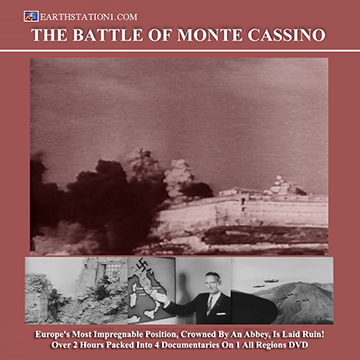
May 18, 1944: The European Civil War:
World War II: The Second European War (The European Theater Of
World War II): The Mediterranean And Middle East Theater Of World
War II: The Italian Campaign Of World War II (The Liberation Of
Italy): The Battle Of Monte Cassino (The Battle For Rome):
Operation Diadem (The Fourth Battle Of Monte Cassino, The Battle
Of The Liri Valley): -- The final battle for Monte Cassino
concludes after the seven days fighting of Operation Diadem as
German paratroopers evacuate Monte Cassino in the face of a daring
Polish II Corps attack that caused the German position to
collapse, causing the Germans to fall back from the Gustav Line to
the Hitler Line some 10 miles to their rear. The Battle of Monte
Cassino, also known as The Battle For Rome and The Battle For
Cassino, was a costly series of four assaults by the Allies
against the Winter Line in Italy held by Axis forces during the
Italian Campaign of World War II. The intention was a breakthrough
to Rome. Monte Cassino, a historic hilltop abbey founded in AD 529
by Benedict of Nursia, dominated the nearby town of Cassino and
the entrances to the Liri and Rapido valleys. Lying in a protected
historic zone, it had been left unoccupied by the Germans,
although they manned some positions set into the steep slopes
below the abbey's walls. Repeated pinpoint artillery attacks on
Allied assault troops caused their leaders to conclude the abbey
was being used by the Germans as an observation post, at the
least. Fears escalated along with casualties and in spite of a
lack of clear evidence, it was marked for destruction. On 15
February American bombers dropped 1,400 tons of high explosives,
creating widespread damage. The raid failed to achieve its
objective, as German paratroopers occupied the rubble and
established excellent defensive positions amid the ruins. Between
17 January and 18 May, Monte Cassino and the Gustav defences were
assaulted four times by Allied troops, the last involving twenty
divisions attacking along a twenty-mile front. The German
defenders were finally driven from their positions, but at a high
cost. The capture of Monte Cassino resulted in 55,000 Allied
casualties, with German losses being far fewer, estimated at
around 20,000 killed and wounded. On Sale @ 15% Off Discount Till
Midnight PT!
https://store.earthstation1.com/the-battle-of-monte-cassino-dvd-world-war-ii-documentaries.html
Today's
EarthStation1.com 15% Off Commemorative Memorial Title: WPIX at
40! (1988) New York City's TV Channel 11 DVD, Download, USB
Today, May 18, 2026
May 18, 1946: #BOTD: #HBD! Reggie
Jackson, African American professional baseball right fielder and
sportscaster, is #born Reginald Martinez Jackson in the Wyncote
neighborhood of Cheltenham Township, just north of Philadelphia,
Pennsylvania. He played 21 seasons in Major League Baseball (MLB)
for the Kansas City / Oakland Athletics, Baltimore Orioles, New
York Yankees, and California Angels. Jackson was inducted into the
National Baseball Hall of Fame in 1993. Jackson was nicknamed "Mr.
October" for his clutch hitting in the postseason with the
Athletics and the Yankees. He helped Oakland win five consecutive
American League West divisional titles, three consecutive American
League pennants and three consecutive World Series titles, from
1972 to 1974. Jackson helped New York win four American League
East divisional pennants, three American League pennants and two
consecutive World Series titles, in 1977 and 1978. He also helped
the California Angels win two AL West divisional titles in 1982
and 1986. Jackson hit three consecutive home runs at Yankee
Stadium in the clinching game six of the 1977 World Series.
Jackson hit 563 career home runs and was an American League (AL)
All-Star for 14 seasons. He won two Silver Slugger Awards, the AL
Most Valuable Player (MVP) Award in 1973, two World Series MVP
Awards, and the Babe Ruth Award in 1977. The Yankees and Athletics
retired his team uniform number in 1993 and 2004. Jackson
currently serves as a special advisor to the Houston Astros.
Jackson led his teams to first place ten times over his 21-year
career. On Sale @ 15% Off Discount Till Midnight PT!
https://store.earthstation1.com/wpix-at-40-channel-11-nyc-1988-tv-retrospec40111988.html
Today's
EarthStation1.com 15% Off Commemorative Memorial Title: Rock! UK:
British Invasion Rock Documentary DVD, Download, Flash Drive
Today, May 18, 2026
May 18, 1949: #BOTD: #HBD! Rick Wakeman,
English keyboardist and composer best known as a former member of
the progressive rock band Yes across five tenures between 1971 and
2004, and for his solo albums released in the 1970s, is #born
Richard Christopher Wakeman in Perivale in West London, Middlesex,
England, where he was raised. Richard Christopher Wakeman CBE quit
his studies at the Royal College of Music in 1969 to become a
full-time session musician. His early sessions included "Space
Oddity", among other tracks, for David Bowie, and songs by
Elton John, Marc Bolan, Cat Stevens, and Lou Reed. In 1970 Wakeman
joined the folk rock group The Strawbs, during which his
virtuosity gained national press coverage. He left in 1971 to join
Yes, with whom he played on some of their most influential albums
across two stints until 1980. During this time Wakeman began a
solo career in 1973 and became an iconic and prominent figure in
progressive rock. His highest-selling and most acclaimed albums
are his first three: The Six Wives of Henry VIII (1973), the UK
number-one Journey to the Centre of the Earth (1974), and The
Myths and Legends of King Arthur and the Knights of the Round
Table (1975), all concept albums. In 1974 he formed his band, The
English Rock Ensemble, with which he toured worldwide and
continues to perform, and went on to score his first major film,
Lisztomania (1975). Wakeman had uneven success in the next two
decades following a change in musical fashion and financial issues
from two divorces. His most popular album was the conceptual
rocker 1984 (1981), which was followed by the minor pop hit single
"Glory Boys" from Silent Nights (1985). He expanded into
other areas such as hosting the television show Gastank, composing
for television and film, forming record labels, and producing his
first New-age, ambient, and Christian music with Country Airs
(1986) and The Gospels (1987), respectively. In 1989 he reunited
with former Yes bandmates for Anderson Bruford Wakeman Howe, which
led to his third period in the group until 1992. Wakeman's most
significant album of the 1990s was Return to the Centre of the
Earth (1999), his first UK Top 40 album in 18 years, and his piano
album Piano Portraits (2017) produced his first UK Top 10 album
since 1975. Starting in 2009, Wakeman revisited his three hit
albums of the 1970s by performing them live with new and expanded
arrangements. From 2016 to 2020, Wakeman was a member of Yes
Featuring Jon Anderson, Trevor Rabin, Rick Wakeman. He continues
to record albums and perform concerts worldwide in various
capacities; his most recent album is A Gallery of the Imagination
(2022). Wakeman's discography includes over 90 solo albums
spanning a range of musical styles. He has also gained notoriety
for his appearances on the television programs Live at Jongleurs,
Countdown, Grumpy Old Men, and Watchdog, and for his radio show on
Planet Rock that aired from 2005 to 2010. Wakeman has written an
autobiography and two memoirs. In 2017, he was inducted into the
Rock and Roll Hall of Fame as a member of Yes. He was awarded a
CBE for his services to music and broadcasting in 2021. On Sale @
15% Off Discount Till Midnight PT!
https://store.earthstation1.com/rock-uk-british-invasion-rock-1960s119601980.html
Today's
EarthStation1.com 15% Off Commemorative Memorial Title: Music
Documentaries III Video Pioneers Tom Waits Turtles DVD, MP4, USB
Today, May 18, 2026
May 18, 1950: #BOTD: #HBD! Mark
Mothersbaugh, American singer, songwriter, composer,
multi-instrumentalist, record producer, author, visual artist and
painter, best known as a founder member of the new wave band Devo,
is #born Mark Allen Mothersbaugh in Akron, Ohio. Mothersbaugh's
music career spans more than 40 years. He came to prominence in
the late 1970s as co-founder, lead singer and keyboardist of the
new wave band Devo, which released a Top 20 hit in 1980 with the
single "Whip It". The band has maintained a cult
following throughout its existence. Mothersbaugh is one of the
main composers of Devo's music and made major lyrical
contributions to the band's songs. He is one of only two members
(along with bass player Gerald Casale) who have been with Devo
throughout its entire history. In addition to his work with Devo,
Mothersbaugh has made music for television series, films and video
games via his production company, Mutato Muzika, most notably as
the composer for the popular long-running animated series Rugrats
for its entire 13-year run, as well as all three theatrical films.
He has also had a solo career which has included four studio
albums: Muzik for Insomniaks, Muzik for the Gallery, Joyeux Mutato
and The Most Powerful Healing Muzik in the Entire World. In 2004,
he was honored with the Richard Kirk award at the BMI Film and TV
Awards for his significant contributions to film and television
music. Additionally, Mothersbaugh was awarded an honorary
doctorate of humane letters from Kent State University in 2008.
His lifelong interest in creating multimedia art pieces has
resulted in gallery exhibitions of items such as his "Beautiful
Mutants" photograph series, postcard diaries, art rugs,
sculptures and musical instruments created from salvaged organ
pipes and bird vocalizations. He has married twice and is the
father of two adopted children. On Sale @ 15% Off Discount Till
Midnight PT!
https://store.earthstation1.com/music-documentaries-iii-dvd-video-pioneers-tom-waits-turtles.html
Today's
EarthStation1.com 15% Off Commemorative Memorial Title: Vietnam:
The Ten Thousand Day War TV Series DVD, Video Download, USB
Today, May 18, 2026
May 18, 1955: The Aftermath Of World War
II: The Cold War: The Cold War In Asia: The Aftermath Of The First
Indochina War (1946-1954) (The Indochina War, The Anti-French
Resistance War, The French-Indochina War): Vietnamese Migration:
The 1954-1955 Great Migration: South Vietnam-United States
Relations: Operation Passage To Freedom: -- The United States Navy
concludes its two-year assistance in the evacuation of 310,000
Vietnamese civilians, soldiers and non-Vietnamese members of the
French Army from communist North Vietnam to South Vietnam
following the end of the First Indochina War. The French and other
countries may have transported a further 500,000. In the wake of
the French defeat at the Battle of Dien Bien Phu, the Geneva
Accords of 1954 decided the fate of French Indochina after eight
years of war between French Union forces and the Viet Minh, which
sought Vietnamese independence. The accords resulted in the
partition of Vietnam at the 17th parallel north, with Ho Chi
Minh's communist Viet Minh in control of the north and the
French-backed State of Vietnam in the south. The agreements
allowed a 300-day period of grace, beginning on July 17, 1954 and
ending on May 18, 1955, in which people could move freely between
the two Vietnams before the border was sealed. The partition was
intended to be temporary, pending elections in 1956 to reunify the
country under a national government. Between 600,000 and one
million northerners moved south, including more than 200,000
French citizens and soldiers in the French army while between
14,000 - 45,000 civilians and approximately 100,000 Viet Minh
fighters moved in the opposite direction. On Sale @ 15% Off
Discount Till Midnight PT!
https://store.earthstation1.com/vietnam-the-10000-day-war-4-dual-layer-dvds-all-13-10000413.html
Today's
EarthStation1.com 15% Off Commemorative Memorial Title: War And
Peace In The Nuclear Age TV Series DVD, Download, USB Drive
Today, May 18, 2026
May 18, 1974: The Aftermath Of World War
II: The Cold War: Nuclear Warfare: Nuclear Weapons Testing: Indian
Nuclear Warfare: Nuclear Weapons Testing: Operation Smiling Buddha
(Operation Happy Krishna): -- India successfully detonates its
first nuclear weapon, becoming the sixth nation to do so.
Officially designated by India's Ministry of External Affairs
(MEA) as Pokhran-I, this test involved an atomic bomb (a-bomb)
with the strength of 8-10 kilotons of TNT detonated by the Indian
Army under the supervision of several key Indian generals at the
Pokhran Test Range (PTR), an army base in Rajasthan, a state in
northern India. Pokhran-I was also the first confirmed nuclear
weapons test by a nation outside the five permanent members of the
United Nations Security Council. Officially, the Indian Ministry
of External Affairs (MEA) claimed this test was a "peaceful
nuclear explosion", but it was an accelerated nuclear
programme. On Sale @ 15% Off Discount Till Midnight PT!
https://store.earthstation1.com/war-and-peace-in-the-nuclear-age-dvd-set-tv-series-7-disc7.html
Today's
EarthStation1.com #OnThisDay Commemorative Memorial Title: Global
Rivals: History Of Cold War w/Marvin Kalb DVD, MP4, USB Drive
Today, May 18, 2026 May 18: National Marvin Day: -- Today's a
day meant for celebrating anyone named Marvin in the world. The
name 'Marvin' is predominantly masculine and is of Welsh origin.
It was derived from the Welsh name 'Mervyn.' The name means 'Sea
Hill' and has been a neglected name for a while now, even though
it was the first name of one of the greatest musicians to ever
live, Marvin Gaye. In the United States, the name rose in
popularity at the beginning of the 20th century and peaked in the
early 1930s. The short form of the name is 'Marv.' The name
'Marvin' gradually rose in the 19th Century and peaked in the
1930s but since then has seen a decline. Its peak period was when
Music legend Marvin Gaye was also born. Alternatives for the name
include Mervin, Marvyn, and Marwin. The female version of Marvin
is 'Marva,' which is in way less usage when compared to Marvin.
The name 'Marvin' is ranked 293rd out of the most popular names in
the United States with an estimated population of 234,468 and is
mostly used as a first name with a prevalence rate of 94%. Drawing
conclusions from the Social Security Administration's database
that analyzes names based on 100 years of data, about 73.53 people
are bearing the name Marvin in every 100,000 people. The data also
shows that Marvin is used as a masculine name 99% of the time!
When comparing the population of people named Marvin based on
race, it is dominated by Caucasians. Caucasians take about 77.7%,
African Americans about 13.6%, Hispanics 5.2%, Asian or Pacific
Islander 1.4%, Mixed races 1.4%, and American Indian or Alaskan
Natives make up 0.6% of the population. In the United States of
America, the state with the most people named Marvin is California
where about 21,322 people bear the name. The state where you are
most likely to meet someone named Marvin is Iowa. In Iowa, in
every 100,000 Iowans you meet, about 166.31 will be named Marvin.
https://store.earthstation1.com/global-rivals-history-of-cold-war-w-mavin-kalb-dvd-mp4-usb-driv4.html
May 18: National Marvin Day: -- Today's a
day meant for celebrating anyone named Marvin in the world. The
name 'Marvin' is predominantly masculine and is of Welsh origin.
It was derived from the Welsh name 'Mervyn.' The name means 'Sea
Hill' and has been a neglected name for a while now, even though
it was the first name of one of the greatest musicians to ever
live, Marvin Gaye. In the United States, the name rose in
popularity at the beginning of the 20th century and peaked in the
early 1930s. The short form of the name is 'Marv.' The name
'Marvin' gradually rose in the 19th Century and peaked in the
1930s but since then has seen a decline. Its peak period was when
Music legend Marvin Gaye was also born. Alternatives for the name
include Mervin, Marvyn, and Marwin. The female version of Marvin
is 'Marva,' which is in way less usage when compared to Marvin.
The name 'Marvin' is ranked 293rd out of the most popular names in
the United States with an estimated population of 234,468 and is
mostly used as a first name with a prevalence rate of 94%. Drawing
conclusions from the Social Security Administration's database
that analyzes names based on 100 years of data, about 73.53 people
are bearing the name Marvin in every 100,000 people. The data also
shows that Marvin is used as a masculine name 99% of the time!
When comparing the population of people named Marvin based on
race, it is dominated by Caucasians. Caucasians take about 77.7%,
African Americans about 13.6%, Hispanics 5.2%, Asian or Pacific
Islander 1.4%, Mixed races 1.4%, and American Indian or Alaskan
Natives make up 0.6% of the population. In the United States of
America, the state with the most people named Marvin is California
where about 21,322 people bear the name. The state where you are
most likely to meet someone named Marvin is Iowa. In Iowa, in
every 100,000 Iowans you meet, about 166.31 will be named Marvin.
https://store.earthstation1.com/global-rivals-history-of-cold-war-w-mavin-kalb-dvd-mp4-usb-driv4.html
Today's
EarthStation1.com #OnThisDay Commemorative Memorial Title: TV
Commercials: The Cable Age Classics I DVD, Download, USB Drive
Today, May 18, 2026May 18: National No Dirty Dishes Day: --
Whether you're a mother, father, sister, brother, or roommate, no
one likes dirty dishes! A holiday most likely created by an upset
parent, National No Dirty Dishes Day has sinks around the world
rejoicing at the thought of having a light workload and a clear
space on this day. So keep sinks happy, and do your part by
saying, "NO" to dirty dishes. Give yourself a break from
the drudgery of dishes for one day, by eating only food that don't
create dirty dishes. Order in, and use disposable containers and
cutlery. If there's anything that ruins a delicious and enjoyable
meal it's having to do dishes afterward. Wouldn't it be great if
there was a day that you didn't have to do any dishes? Thankfully
that's the purpose of National No Dirty Dishes Day! You can head
out to eat at a local restaurant rather than cooking at home or
just decide to use disposable dishes and silverware. Either way,
the goal is to not do any dishes on National No Dirty Dishes Day!
Disposable dishes aren't exactly a recent innovation. The paper
plate was first invented in 1867 by a man by the name of Hermann
Henschel. While it was a matter of convenience at the time, it
became a matter of public health in 1908. During this era,
tuberculosis was a serious problem. When Dr. Samuel J Crumbine saw
one of his patients drinking from the common water source he knew
something had to change. He developed a movement to eliminate
common utensils being used at public sources. This led inventors
Hugh Moore and Lawrence Luellen to create one of the most popular
disposable cups today, the Dixie Cup. This innovation led to an
explosion in disposable dishware including disposable bowls and
plates, paper wrappers for food, and wooden cutlery. These quickly
became the common way to feed people who were working at remote
locations like bridges, dams, and roads. The 1940s saw a boom in
defense factories, and disposable dishes were used to feed the
workers there. Restaurants, the other option for National No Dirty
Dishes Day, have been around for as long as humans have gathered.
The convenience of having someone else make your food and not
having to clean up afterward was a huge draw to these businesses.
The ability to socialize with others while enjoying a meal was
also significant.
https://store.earthstation1.com/tv-commercials-the-cable-age-classics-i-dvd.html
Today's
EarthStation1.com #OnThisDay Commemorative Memorial Title: The
Whistler Crime & Mystery Radio Drama MP3 DVD Download USB
Drive
Today, May 18, 2026May 18: Mother Whistler Day: -- This is
NOT a celebration of the mother of American artist James Abbott
McNeill Whistler (whom this day takes its name from) -- rather,
it's a day to celebrate whistling! Most people can whistle,
however, not everyone can. You might ask why celebrate something
like whistling? Well, because why not? Life is too short to choose
not to celebrate things, especially things that if done well can
be a melodious sound. Whistling is emitting a clear, high-pitched
sound by forcing breath through a small hole between one's lips or
teeth and has been used in movies, songs, and other arts. James
Abbot McNeil Whistler was an American artist who began painting
the portrait of his mother when the model he had scheduled to
paint unexpectedly didn't arrive. It then turned out to be one of
the most popular paintings in the world. It is one of the few
paintings done by an American artist but does not reside in
America. The painting is called Arrangement in Gray and Black No.
1 and now resides at Musee d'Orsay in Paris, having been bought by
the French state in 1891.The subject of the painting is Whistler's
mother, Anna McNeill Whistler. The painting is 56.81 by 63.94
inches (1,443 mm _ 1,624 mm) and she posed for the painting while
living in London with her son at Cheyne Walk, Chelsea. The work
was shown at the 104th Exhibition of the Royal Academy of Art in
London (1872), after coming close to being rejected by the
Academy. The work became so popular, attracting several imitators
and featuring in Paris's Musee du Luxembourg when Whistler pawned
it. After popular philosopher, Thomas Carlyle viewed the painting,
he agreed to sit for a similar composition and was titled
Arrangement in Grey and Black, No. 2, making the previous painting
Arrangement in Grey and Black, No. 1 by default. The Mother
Whistler has featured in music and movies, making appearances over
the years in movies like "Bean" in 1997 and Will Smith's
"I Am Legend" in 2007, amongst a host of others.
https://store.earthstation1.com/the-whistler-radio-mp3-dvd-complete-broadcast3.html
Today's
EarthStation1.com #OnThisDay Commemorative Memorial Title: Abraham
Lincoln Documentaries Set MP4 Video Download Or DVD
Today, May 18, 2026May 18, 1860: The American Civil War (The
Civil War, The War Between The States): The 1860 United States
Presidential Election: The 1860 Republican National Convention: --
Abraham Lincoln wins the Republican Party presidential nomination
over William H. Seward, who later becomes the United States
Secretary Of State. The 1860 Republican National Convention was a
presidential nominating convention that met May 16-18 in Chicago,
Illinois. It was held to nominate the Republican Party's
candidates for president and vice president in the 1860 election.
The convention selected former representative Abraham Lincoln of
Illinois for president and Senator Hannibal Hamlin of Maine for
vice president. Entering the 1860 convention, Senator William H.
Seward of New York was generally regarded as the front-runner, but
Lincoln, Governor Salmon P. Chase of Ohio, former representative
Edward Bates of Missouri, and Senator Simon Cameron of
Pennsylvania all commanded support from a significant share of
delegates. Seward led on the first ballot but fell short of a
majority, while Lincoln finished in a strong second place.
Cameron's delegates shifted to Lincoln on the second ballot,
leaving Lincoln essentially tied with Seward. Lincoln clinched the
nomination on the third ballot after consolidating support from
more delegates who had backed candidates other than Seward. Hamlin
was nominated on the second vice presidential ballot, defeating
Cassius Clay of Kentucky (after whom fellow Kentuckian Muhammad
Ali was named) and several other candidates. The ticket of Lincoln
and Hamlin went on to win the 1860 general election. After taking
office in 1861, Lincoln appointed all four of his major opponents
to his cabinet: Seward for Secretary Of State, Chase for Secretary
Of The Treasury (and later for chief justice), Bates for Attorney
General, and Cameron for Secretary Of War. It was Lincoln's
election as president on November 6, 1860 that immediately
precipitated The American Civil War.
https://store.earthstation1.com/abraham-lincoln-documentaries-dvd.html
Today's
EarthStation1.com #OnThisDay Commemorative Memorial Title:
Unauthorized Biography: Richard Nixon DVD, Video Download, USB
Drive
Today, May 18, 2026May 18, 1971: The Civil Rights Movement:
The Post-Civil Rights Era (1969-Present): The Congressional Black
Caucus: The Sixty-One Demands Of The Congressional Black Caucus:
-- President Richard Nixon, who had a March 25, 1971 meeting with
all thirteen founders of the Congressional Black Caucus (CBC), a
meeting Nixon refused having for a year (resulting in the caucus
boycotting his 1971 State Of The Union Address), a meeting held
five days prior to caucus formally founding itself -- issues a 112
page response to the 61 demands made by the CBC caucus (initially
reported as only being 60; the National Archives records 61) in
their 32 page proposal, rejecting some of their major proposals
but saying he agreed with several others. The CBC's boycott of
Nixon's SOTU address, which the CBC said was their response to
Nixon's demonstrated disregard of African American interests,
resulted in a lot of media attention, and forced Nixon to meet
with them. The CBC's recommendations were plans to eradicate
racism, provide quality housing, and promote engagement of African
Americans in government. The thirteen founding members (Shirley
Chisholm, Bill Clay, George W. Collins, John Conyers, Ron Dellums,
Charles Diggs, Augustus F. Hawkins, Ralph Metcalfe, Parren
Mitchell, Robert N.C. Nix Sr., Charles Rangel, Louis Stokes, and
Walter E. Fauntroy) presented the president with a package of
demands for aid to minorities. Their proposal resulted not only
with rejection by the president, but also they and all other off
the members of the caucus were thereafter included on Nixon's
master list of political opponents. This secret list was compiled
by Nixon's Presidential Counselor Charles Colson, and was an
expansion of the original Nixon's Enemies List of 20 key people
considered opponents of President Richard Nixon, which contained
220 people and organizations..The master list was compiled in
mid-1971 in Charles Colson's office and sent in memorandum form to
John Dean. On June 27, 1973, Dean provided to the Senate Watergate
Committee this updated "master list" of political
opponents. The original list had multiple sections, including a
section for "Black Congressmen". The purpose of the list
was, according to the list, to "use the available Federal
machinery to screw political enemies." One such scheme
involved using the Internal Revenue Service to harass people on
the list. Nixon rejected the group's proposal for welfare payments
of 6,500 USD, saying his own proposed program "combines a
more realistic payment level with fiscal responsibility." The
President's plan also includes work requirements and work
incentives, such as child care. The President also rejected
request for 50M USD for development of minority business
enterprises. To the CBC's proposal for immediate executive action
to open more sites for low-income housing, Mr. Nixon replied, "An
Administration policy on site selection is presently under
consideration as part of a cornprensive review of this and other
complex related issues." To other concerns expressed by the
CBC, the President said that he had made the fight against hunger
and malnutrition one of his highest priorities, that the
Administration had taken significant steps to increase management
and technical assistance to minority businesses, that the Office
of Economic Opportunity should be free of proven programs as they
become "mature" so thai, the office could "continue
its primary mission as innovator and advocate for the poor,"
and that education revenue sharing would greatly aid disadvantaged
children. Mr. Nixon gave a lengthy response to black concerns
about preventive detention and noknock entry by the police that
are in effect in the District of Columbia. He said the need for
those provisions was urgent in the fight against crime in the
city. Mr. Nixon said he agreed with the black legislators, all
Democrats, that there should be a revenue-sharing program, but the
caucus denied that the group was in agreement with the President
on that point, and was concerned that Mr. Nixon misinterpreted the
wording of certain other proposals to feel there was agreement. In
two-and-one-half page cover letter to the caucus, the President
said he was encouraged that there was agreement in three
"especially critical areas." "We share a
determination to reform the welfare system so that it will help
solve, rather than aggravate the problems of those who lack a
minimum income," Mr. Nixon said in the letter addressed to
the caucus chairman, Representative Charles C. Diggs Jr. of
Michigan. "You attached high priority, as I do, to a program
of revenue sharing that will enable our cities and states to serve
the people better. And you are committed, as I am. to a concerted
drive for expanded economic opportunities for minorities and all
other Americans-a drive to validate with jobs, income and tangible
benefits the pledges this society has made to the disadvantaged in
the past decade." Mr. Nixon said the CBC's proposals gave the
Administion a chance to review its entire civil rights record. He
said the document was put together by the Council of Domestic
Affairs and the Office of Management and Budget. In a progress
report prepared by George P. Shultz -- then the director of the
Office of Management and Budget, in future Nixon's Secretary Of
State and Reagan's Secretary Of State -- the Administration
congratulated itself for improvements in such areas of civil
rights as equal education, employment in the various construction
plans, enforcement through the Equal 'Employment Opportunities
Commission and the administration of justice. In short, Nixon told
the CBC that they were already doing a great job - and that his
administration would continue to support "jobs, income and
tangible benefits, the pledges that this society has made to the
disadvantaged in the past decade." The CBC, however,
expressed deep disappointment with Nixon's reply, and said the
Nixon administration "lacked a sense of understanding,
urgency and commitment in dealing with the critical problems
facing Black Americans."
https://store.earthstation1.com/unauthorized-biography-richard-nixon-dvd-documentary.html
Today's
EarthStation1.com #OnThisDay Commemorative Memorial Title:
Napoleon (1955) Raymond Pellagrin Orson Welles DVD, Download, USB
Today, May 18, 2026May 18, 1803: The Age Of Enlightenment
(The Enlightenment, The Age Of Reason): The Age Of Revolution: The
Atlantic Revolutions: The French Revolution: The Napoleonic Wars:
The United Kingdom In The Napoleonic Wars: War Between Britain And
France (1803-1814): -- The United Kingdom ends its uneasy truce
with France by revoking its assent to The Treaty Of Amiens that
ended The War Of The Second Coalition and declares war on France.
The British were increasingly angered by Napoleon's reordering of
the international system in Western Europe, especially in
Switzerland, Germany, Italy and the Netherlands. Kagan argues that
Britain was especially alarmed by Napoleon's assertion of control
over Switzerland. The British felt insulted when Napoleon said it
deserved no voice in European affairs (even though King George was
an elector of the Holy Roman Empire) and sought to restrict the
London newspapers that were vilifying him. Britain had a sense of
loss of control, as well as loss of markets, and were worried by
Napoleon's possible threat to its overseas colonies. McLynn argues
that Britain went to war in 1803 out of a "mixture of
economic motives and national neuroses-an irrational anxiety about
Napoleon's motives and intentions." McLynn concludes that it
proved to be the right choice for Britain because, in the long
run, Napoleon's intentions were hostile to the British national
interest. Napoleon was not ready for war, and so this was the best
time for Britain to stop them. Britain seized upon the Malta
issue, refusing to follow the terms of the Treaty of Amiens and
evacuate the island. The deeper British grievance was their
perception that Napoleon was taking personal control of Europe,
making the international system unstable, and forcing Britain to
the sidelines. Numerous scholars have argued that Napoleon's
aggressive posture made him enemies and cost him potential allies.
As late as 1808, the continental powers affirmed most of his gains
and titles, but the continuing conflict with Britain led him to
start the Peninsular War and the invasion of Russia, which many
scholars see as a dramatic miscalculation. The Treaty Of Amiens
temporarily ended hostilities between the French Republic and
Great Britain during the French Revolutionary Wars. It was signed
in the city of Amiens on March 25, 1802 (Germinal 4, year X, in
the French Revolutionary calendar), by Joseph Bonaparte and the
Marquess Cornwallis as a "Definitive Treaty of Peace".
The consequent Peace of Amiens lasted only one year (18 May 1803)
and engendered the only period of general peace in Europe between
1793 and 1814. Under the treaty, Britain recognised the French
Republic; the British parliament had dropped England's historical
claim to the now-defunct French Kingdom only two years previously.
Together with the Treaty of Luneville (1801), the Treaty Of Amiens
marked the end of the Second Coalition (European monarchies led by
Britain, Austria and Russia, and including the Ottoman Empire,
Portugal, Naples, various German monarchies and Sweden), which had
waged war against Revolutionary France since 1798.
https://store.earthstation1.com/napoleon-1955-dvd-raymond-pellagrin-orson-welles-2-19552.html
Today's
EarthStation1.com #OnThisDay Commemorative Memorial Title: Arab
And Jew: Wounded Spirits In A Promised Land DVD, Download, USB
Today, May 18, 2026May 18, 1951: The Aftermath Of World War
II: The Cold War: The Arab-Israeli Conflict: The 1948 Palestine
War: The 1948 Arab-Israeli War (The First Arab-Israeli War): The
United Nations Truce Supervision Organization (UNTSO): United
Nations Security Council Resolution 93 (UNSCR93): -- After hearing
a report from the Chief Of Staff of the United Nations Truce
Supervision Organization in Palestine, the representatives of
Egypt and Israel, as well as the Egyptian-Israel Mixed Armistice
Commission, determine that a "prearranged and planned attack
ordered by Israel authorities" was "committed by Israeli
regular army forces against the Egyptian regular army" in the
Gaza Strip on February 28, 1951, The United Nations adopts United
Nations Security Council Resolution 93, which condemned this
attack as a violation of the cease-fire previsions of UNSC
Resolution 54 and as inconsistent with the obligations of the
parties under the General Armistice Agreement between Egypt and
Israel and under the United Nations Charter. The Council again
called upon Israel to take all necessary measures to prevent such
actions and expressed its conviction that the maintenance of the
General Armistice Agreement is threatened by any deliberate
violation of it and that no progress towards the return of peace
in Palestine can be made until both parties comply strictly with
their obligations. The resolution was adopted with ten votes; the
Soviet Union abstained.
https://store.earthstation1.com/arab-and-jew-wounded-spirits-in-a-promised-land-dvd.html
Today's
EarthStation1.com #OnThisDay Commemorative Memorial Title: The
Bolshoi Ballet 2 Part TV Series DVD, Video Download, USB Drive
Today, May 18, 2026May 18 (?), 1995: #DOTD: #RIP: Alexander
Godunov, Russian-American ballet dancer and film actor (b.
November 28, 1949) #dies; on May 18, 1995, Godunov's friends
became concerned when he had been uncharacteristically quiet with
his phone calls. A nurse who had not heard from him since May 8
went to his home in the Shoreham Towers, West Hollywood,
California, where his body was discovered. Godunov's death was
later determined to be caused by complications from hepatitis due
to chronic alcoholism. His ashes were scattered into the Pacific
Ocean; his memorial at Gates Mortuary in Los Angeles is engraved
with the epitaph "His future remained in the past.".
Alexander Borisevich Godunov was born in Sakhalin, Russian SFSR,
in the Russian Far East. Godunov began his ballet studies in Riga
in 1958, in the same class as Mikhail Baryshnikov. The two became
friends and helped each other throughout their years there.
Godunov joined the Bolshoi Ballet in 1971 and rose to become
Premier danseur. Godunov caused a diplomatic incident between the
United States and the Soviet Union when he defected to the United
States on August 21, 1979, while on a tour with the Bolshoi Ballet
in New York City, when Godunov contacted authorities and asked for
political asylum. After discovering his absence, the KGB responded
by putting his wife, Lyudmila Vlasova, a soloist with the company,
on a plane to Moscow, but the flight was stopped before takeoff.
After three days, with involvement by President Jimmy Carter and
Soviet leader Leonid Brezhnev, the U.S. State Department was
satisfied that Vlasova had chosen to return to the Soviet Union of
her own free will, and allowed the plane to depart. This incident
was dramatised in a 1986 movie, Flight 222. Vlasova later said
that while Godunov loved American culture and had long desired to
live in the United States, she felt she was "too Russian"
to live in the United States. The couple divorced in 1982. Godunov
joined the American Ballet Theatre and danced as a principal
dancer until 1982 when he had a falling-out with long-time friend
and director of the company Mikhail Baryshnikov. The official
reason for his release from the company was that there would not
be sufficient roles for him after a change in the repertory. He
then traveled with his own troupes, danced as a guest artist with
different prominent ballet companies worldwide, and turned to
acting in Hollywood. Godunov's acting roles were varied, including
a good-natured Amish farmer in Witness (1985), a comically
narcissistic symphony conductor (referred to as "the
maestro") in The Money Pit (1986), and a violent German
terrorist in Die Hard (1988). He turned down many roles which
typecast him as a dancer or another heavy as in Die Hard. Doing
such hampered his career and he didn't achieve movie-star status.
In 1981, Godunov met actress Jacqueline Bisset at a party in New
York City. They began a long-term relationship six months later.
They broke up in 1988. Godunov became a naturalized citizen of the
United States in 1987.
https://store.earthstation1.com/the-bolshoi-ballet-complete-2-part-tv-documentary-series-dv2.html
Today's
EarthStation1.com #OnThisDay Commemorative Memorial Title: Outer
Space Films 3 Project Apollo Reaching For The Moon DVD, MP4, USB
Today, May 18, 2026May 18, 1969: Rocket Launches: The
History Of Spaceflight: The Aftermath Of World War II: The Cold
War: The Space Age: Space Programs Of The United States: Human
Spaceflight Programs: Missions To The Moon: Project Apollo
(AS-10): -- NASA launches Apollo 10, an the F mission "dress
rehearsal" for the first Moon landing to test all of the
components and procedures of an Apollo Moon landing mission just
short of actually landing, at 16:49:00 UTC from the Kennedy Space
Center Launch Complex 39B ( (LC-39B) on Merritt Island, Florida,
with Astronauts Thomas P. Stafford, John W. Young and Eugene A.
Cernan on board, the fourth manned mission in the United States
Apollo space program, and the second (after Apollo 8) to orbit the
Moon. The Lunar Module (LM) followed a descent orbit to within 8.4
nautical miles (15.6 km) of the lunar surface, at the point where
powered descent for landing would normally begin. Its success
enabled the first landing to be attempted on the Apollo 11 mission
two months later. According to the 2002 Guinness World Records,
Apollo 10 set the record for the highest speed attained by a
manned vehicle: 39,897 km/h (11.08 km/s or 24,791 mph) on May 26,
1969, during the return from the Moon. The mission's call signs
included the names of the Peanuts characters Charlie Brown and
Snoopy, which became Apollo 10's semi-official mascots. Peanuts
creator Charles Schulz also drew some mission-related artwork for
NASA.
https://store.earthstation1.com/outer-space-films-3-project-apollo-reaching-for-the-moon-dv3.html
Today's
EarthStation1.com #OnThisDay Commemorative Memorial Title: The
Mozart Mystique w/ Peter Ustinov DVD, MP4 Download, USB Drive
Today, May 18, 2026May 18, 1799: #DOTD: #RIP: Pierre
Beaumarchais, French polymath, playwright, financier, watchmaker,
inventor, musician, diplomat, spy, publisher, horticulturist, arms
dealer, satirist, and revolutionary (both French and American) (b.
January 24, 1732) #dies aged 67 in the city of his birth, Paris,
France, where he lived since 1796 after he was falsely declared an
emigre (a loyalist of the old regime) by his enemies and had to
spend two and a half years in exile, mostly in Germany, until his
name was removed from the list of proscribed emigres. Beaumarchais
is buried in the Pere Lachaise Cemetery in Paris. Boulevard
Beaumarchais in Paris is named after him. Pierre-Augustin Caron de
Beaumarchais was born a provincial watchmaker' son. He rose in
French society and became influential in the court of Louis XV as
an inventor and music teacher. He made a number of important
business and social contacts, played various roles as a diplomat
and spy, and had earned a considerable fortune before a series of
costly court battles jeopardized his reputation. An early French
supporter of American independence, Beaumarchais lobbied the
French government on behalf of the American rebels during the
American War of Independence. Beaumarchais oversaw covert aid from
the French and Spanish governments to supply arms and financial
assistance to the rebels in the years before France' formal entry
into the war in 1778. He later struggled to recover money he had
personally invested in the scheme. Beaumarchais was also a
participant in the early stages of the French Revolution. He is
probably best known, however, for his theatrical works, especially
the three Figaro plays.
https://store.earthstation1.com/the-mozart-mystique-dvd-peter-ustinov-2-part-tv-serie2.html
Today's
EarthStation1.com #OnThisDay Commemorative Memorial Title: The
Romantic Spirit TV Series DVD, Video Download, USB Flash Drive
Today, May 18, 2026May 18, 1911: #DOTD: #RIP: Gustav Mahler,
Austrian composer and conductor (b. July 7, 1860) #dies in a coma
at the Low sanatorium in Vienna, Austria of pneumonia caused by
bacterial endocarditis, an infection of the inner surface of the
heart, aged 49. Mahler was buried in the Grinzing, Germany
cemetery on May 22, 1911 next to his daughter Maria, as he had
requested,. His tombstone is inscribed only with his name because
"any who come to look for me will know who I was and the rest
don't need to know.". Gustav Mahler was an Austro-Bohemian
Romantic composer, and one of the leading conductors of his
generation. As a composer he acted as a bridge between the 19th
century Austro-German tradition and the modernism of the early
20th century. While in his lifetime his status as a conductor was
established beyond question, his own music gained wide popularity
only after periods of relative neglect, which included a ban on
its performance in much of Europe during the Nazi era. After 1945
his compositions were rediscovered by a new generation of
listeners; Mahler then became one of the most frequently performed
and recorded of all composers, a position he has sustained into
the 21st century. In 2016, a BBC Music Magazine survey of 151
conductors ranked three of his symphonies in the top ten
symphonies of all time. Born in Bohemia (then part of the Austrian
Empire) to Jewish parents of humble origins, the German-speaking
Mahler displayed his musical gifts at an early age. After
graduating from the Vienna Conservatory in 1878, he held a
succession of conducting posts of rising importance in the opera
houses of Europe, culminating in his appointment in 1897 as
director of the Vienna Court Opera (Hofoper). During his ten years
in Vienna, Mahler, who had converted to Catholicism to secure the
post-experienced regular opposition and hostility from the
anti-Semitic press. Nevertheless, his innovative productions and
insistence on the highest performance standards ensured his
reputation as one of the greatest of opera conductors,
particularly as an interpreter of the stage works of Wagner,
Mozart, and Tchaikovsky. Late in his life he was briefly director
of New York's Metropolitan Opera and the New York Philharmonic.
Mahler's oeuvre is relatively limited; for much of his life
composing was necessarily a part-time activity while he earned his
living as a conductor. Aside from early works such as a movement
from a piano quartet composed when he was a student in Vienna,
Mahler's works are generally designed for large orchestral forces,
symphonic choruses and operatic soloists. These works were
frequently controversial when first performed, and several were
slow to receive critical and popular approval; exceptions included
his Second Symphony, Third Symphony, and the triumphant premiere
of his Eighth Symphony in 1910. Some of Mahler's immediate musical
successors included the composers of the Second Viennese School,
notably Arnold Schoenberg, Alban Berg and Anton Webern. Dmitri
Shostakovich and Benjamin Britten are among later 20th-century
composers who admired and were influenced by Mahler. The
International Gustav Mahler Institute was established in 1955 to
honour the composer's life and achievements.
https://store.earthstation1.com/the-romantic-spirit-tv-series-all-14-episodes-5-dual-layer-d145.html
Today's
EarthStation1.com #OnThisDay Commemorative Memorial Title:
Monarchy In The UK: British Royal History MP4 Video Download DVD
Set
Today, May 18, 2026May 18, 1152: The English Monarchy (The
Monarchy Of The Kingdom Of England): The French Monarchy (The
Monarchy Of The Kingdom Of France): Royal Weddings: -- The future
Henry II Of England marries Eleanor Of Aquitaine. He would become
king two years later, after the death of his cousin once removed,
King Stephen of England. Henry II, also known as Henry Curtmantle
(French: Court-manteau), Henry FitzEmpress or Henry Plantagenet,
who ruled as Count of Anjou, Count of Maine, Duke of Normandy,
Duke of Aquitaine, Count of Nantes, King of England and Lord of
Ireland, and at various times also controlled Wales, Scotland and
Brittany (March 5, 1133 - July 6, 1189) is #born Henry Plantagenet
in Normandy at Le Mans, the eldest child of the Empress Matilda -
also known as the Empress Maude, one of the claimants to the
English throne during the civil war known as the Anarchy - and her
second husband, Geoffrey Plantagenet, Count of Anjou. In 1151,
Henry married Eleanor Of Aquitaine, whose marriage to Louis VII of
France had recently been annulled. On December 19, 1154: he was
crownd Henry II Of England at Westminster Abbey. Henry was an
energetic and sometimes ruthless ruler, driven by a desire to
restore the lands and privileges of his grandfather Henry I.
During the early years of his reign the younger Henry restored the
royal administration in England, re-established hegemony over
Wales and gained full control over his lands in Anjou, Maine and
Touraine. Henry's desire to reform the relationship with the
Church led to conflict with his former friend Thomas Becket, the
Archbishop of Canterbury. This controversy lasted for much of the
1160s and resulted in Becket's murder in 1170. Henry soon came
into conflict with Louis VII and the two rulers fought what has
been termed a "cold war" over several decades. Henry
expanded his empire, often at Louis' expense, taking Brittany and
pushing east into central France and south into Toulouse; despite
numerous peace conferences and treaties, no lasting agreement was
reached. By 1172, he controlled England, large parts of Wales, the
eastern half of Ireland and the western half of France, an area
that would later come to be called the Angevin Empire. Henry and
Eleanor had eight children. As they grew up, tensions over the
future inheritance of the empire began to emerge, encouraged by
Louis and his son King Philip II. In 1173 Henry's heir apparent,
"Young Henry", rebelled in protest; he was joined by his
brothers Richard and Geoffrey and by their mother, Eleanor.
France, Scotland, Brittany, Flanders, and Boulogne allied
themselves with the rebels. The Great Revolt was only defeated by
Henry's vigorous military action and talented local commanders,
many of them "new men" appointed for their loyalty and
administrative skills. Young Henry and Geoffrey revolted again in
1183, resulting in Young Henry's death. The Norman invasion of
Ireland provided lands for his youngest son John, but Henry
struggled to find ways to satisfy all his sons' desires for land
and immediate power. Philip successfully played on Richard's fears
that Henry would make John king, and a final rebellion broke out
in 1189. Decisively defeated by Philip and Richard and suffering
from a bleeding ulcer, Henry retreated to Chinon castle in Anjou,
where he died. Henry's empire quickly collapsed during the reign
of his youngest son John, however many of the changes Henry
introduced during his long rule had long-term consequences.
Henry's legal changes are generally considered to have laid the
basis for the English Common Law, while his intervention in
Brittany, Wales and Scotland shaped the development of their
societies and governmental systems. "The Lion in Winter"
is a 1966 play by James Goldman, depicting the personal and
political conflicts of Henry II Of England, his wife Eleanor Of
Aquitaine, their children and their guests during Christmas 1183.
It premiered on Broadway at the Ambassador Theatre on March 3,
1966, starring Robert Preston and Rosemary Harris, who won a Tony
Award for her portrayal of Eleanor. It was adapted by Goldman into
an Academy Award-winning 1968 film of the same name, starring
Peter O'Toole and Katharine Hepburn. The play has been produced
numerous times, including Broadway and West End revivals.
https://store.earthstation1.com/monarchy-in-the-uk-british-royal-history-mp4-video-download-dvd-set.html
Today's
EarthStation1.com #OnThisDay Commemorative Memorial Title: Walt
Disney: The Story Of Robin Hood (1956) DVD, Download, USB Drive
Today, May 18, 2026May 18, 1988: #DOTD: #RIP: Anthony
Forwood, English actor, life partner of Dirk Bogarde (b. October
3, 1915) #dies of liver cancer and Parkinson's disease aged 72 in
Kensington and Chelsea, London. At this time Bogarde, a heavy
smoker, Bogarde had had a minor stroke. His body was cremated, and
the ashes presumably given to Bogarde. Anthony Forwood was born
Ernest Lytton Leslie Forwood in Weymouth, Dorset, England. The
Forwood family were landed gentry; Forwood's great-grandfather,
Thomas Friend Brittain Peploe Forwood, resided in Thornton Manor
in Cheshire and was the forefather of the Forwood Baronetcy.
Forwood's great-uncles were English merchants, shipowners and
politicians Sir Arthur Forwood, 1st Baronet and Sir William Bower
Forwood; his father was Leslie Langton Forwood, a captain in the
Royal Navy. After years of theatre, including the revue This World
of Ours in 1935; Forwood gained his first film acting role in
1949, when he starred in Ralph Thomas' Traveller's Joy. That same
year he appeared in the thriller The Man in Black with Sid James.
In 1952, he received a number of roles including Appointment in
London with Dirk Bogarde; he eventually became his life partner
and manager. Ralph Thomas, who had directed Forwood in his first
film role, directed Bogarde in Doctor in the House and several of
its sequels. Forwood appeared with Boris Karloff in the mystery
Colonel March Investigates and played Will Scarlet in The Story of
Robin Hood and His Merrie Men (1952). One year later he acted in
the Oscar-nominated Knights of the Round Table, a film starring
such high-profile actors as Robert Taylor, Ava Gardner and Stanley
Baker, and in Terence Fisher's Mantrap (1953). His last role came
in 1956 in Colonel March of Scotland Yard. In 1942, Forwood
married actress Glynis Johns, but they divorced in 1948. Their
only child was actor Gareth Forwood (1945-2007). Forwood later
lived with his long-term partner, actor Dirk Bogarde, in Amersham,
England, and then in France before the couple returned to England
shortly before Forwood died.
https://store.earthstation1.com/walt-disney39s-disneyland-the-story-of-robin-hood-1956-391956.html
Today's
EarthStation1.com #OnThisDay Commemorative Memorial Title: The
Good Old Time TV Theme Song MP3 CD, Audio Download, USB Drive
Today, May 18, 2026May 18, 1995: #DOTD: #RIP: Elizabeth
Montgomery, American actress and beauty whose career spanned five
decades in film, stage, and television, best known as the good
witch Samantha Stephens on the popular television series Bewitched
(b. April 15, 1933) #dies in her sleep at 8:22 a.m. Pacific Time
at her Beverly Hills home, which she shared with her fourth
husband, fellow TV actor Robert Foxworth, whom she had lived with
for almost twenty years and then married in 1993. On June 18,
1995, exactly one month after her death, a memorial service was
held at the Canon Theatre in Beverly Hills. Herbie Hancock played
music, and American writer, investigative journalist, and producer
Dominick Dunne spoke about the early years of their friendship
when both of them lived in New York City. Other speakers included
Montgomery's widower, who read sympathy cards which were sent to
him by fans, her nurse, her brother, her daughter, and her
stepson. Her body was cremated at the Westwood Village Memorial
Park Cemetery, and her ashes scattered in the Pacific Ocean.
Elizabeth Montgomery was born Elizabeth Victoria Montgomery to
Broadway actress Elizabeth Daniel Bryan Allen and film star actor,
director and producer Robert Montgomery. Elizabeth Montgomery
began her career in the 1950s with a role on her father's
television series Robert Montgomery Presents, and she won a
Theater World Award for her 1956 Broadway debut in the production
Late Love. In the 1960s, she was celebrated for her role as
Samantha Stephens on the ABC sitcom Bewitched. Her work on the
series earned her five Primetime Emmy Award nominations and four
Golden Globe Award nominations. After Bewitched ended its run in
1972, Montgomery continued her career with roles in numerous
television films, including A Case of Rape (1974), as Ellen
Harrod, and The Legend of Lizzie Borden (1975), as Lizzie Borden.
Both roles earned her additional Emmy Award nominations.
Throughout her career, Montgomery was devoted to various forms of
liberal political activism and charitable work. She lent her name,
along with a large amount of her time, money, and energy, to a
wide variety of charitable and political causes. She was a
champion of women's rights, AIDS activism, and gay rights. She was
also an ardent critic of the Vietnam War, and in later years, she
was an active advocate for AIDS research and outreach to the
disabled community. Professionally, she lent her voice as the
narrator of two political documentaries which were critical of
U.S. foreign policy, Cover Up: Behind the Iran Contra Affair
(1988) and its Academy Award-winning sequel The Panama Deception
(1992). In June 1992, Montgomery and her former Bewitched co-star
and good friend Dick Sargent, were grand marshals at the Los
Angeles Gay Pride Parade. During the last year of her life,
Montgomery was a volunteer at the Los Angeles Unit of Learning
Ally, a nonprofit organization which records educational books on
specially formatted CDs as well as in downloadable formats for
disabled people. In 1994, Montgomery produced several radio and
television public-service announcements for Learning Ally's Los
Angeles unit. In January 1995, she recorded the 1952 edition of
the best-selling book of poetry titled When We Were Very Young by
A. A. Milne for Learning Ally.
https://store.earthstation1.com/tv-theme-song-mp3-cd-classic-old-time-televisio3.html